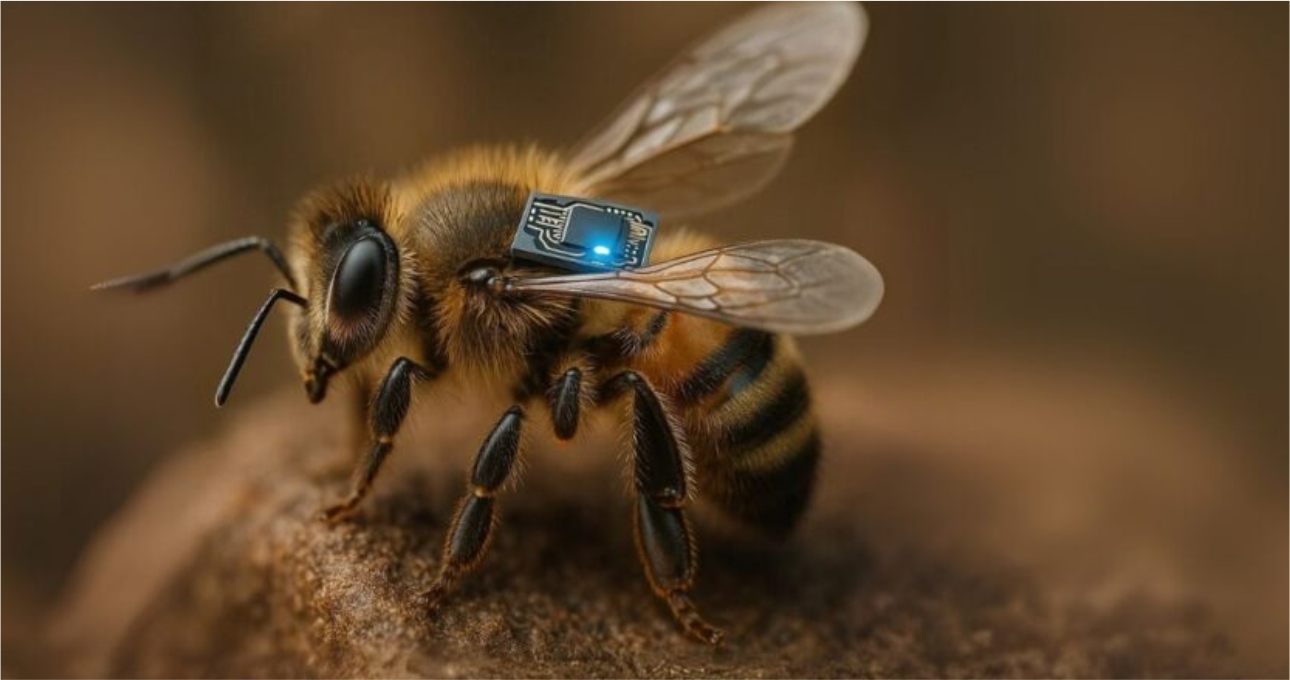
Beijing, China: In a groundbreaking development that blurs the lines between biology and robotics, a team of Chinese scientists has unveiled the world’s lightest brain chip, capable of remotely controlling insects—most notably bees—turning them into living drones for surveillance and environmental monitoring.
The ultra-lightweight chip, weighing less than 5 milligrams, can be implanted onto the back of a bee without hindering its flight or natural behavior. Powered by wireless charging and equipped with neuromodulation technology, the chip allows researchers to send directional signals to the bee’s brain, steering it with remarkable precision.
According to lead researcher Dr. Li Wei from the Beijing Institute of Intelligent Technology, the goal is to “integrate biology and electronics to develop a new generation of micro-drones that are energy-efficient, stealthy, and capable of accessing hard-to-reach environments.”
- Weight: < 5 mg – the lightest ever created
- Control: Real-time wireless navigation via neural stimulation
- Applications: Military reconnaissance, search and rescue, environmental monitoring, and pollination enhancement
The project, while revolutionary, has also sparked global ethical concerns. Critics warn that such technology could lead to privacy violations, weaponization of animals, and raise serious bioethics questions about manipulating living creatures.
Despite controversy, the Chinese research team insists their work is currently focused on peaceful applications like agriculture monitoring, forest fire detection, and search-and-rescue in disaster zones.
This innovation pushes the frontier of cyborg insect technology, a field once confined to science fiction, now stepping firmly into reality. Governments and tech industries worldwide are closely monitoring the progress, signaling what may be the dawn of a new era in biological robotics.